Help us find better antidepressant choices for people with depression
The Australian Genetics Depression Study – Cellomics Study (AGDS-CellO) is looking for up to 150 adults who have never had depression or an anxiety or mood disorder. Your samples give researchers the comparison they need.
Study Update: Recruiting For Population Control Group

About the Study
Why we are doing this research
Depression looks different in every person, and so does the response to treatment. Some people do well on the first antidepressant they try. Others go through several before they find one that helps.
This study uses cells grown from a blood sample to look for biological differences between people who responded particularly well, or particularly poorly, to specific classes of antidepressant. Over the long term, we hope this leads to more personalised prescribing.
We’re also asking whether antidepressants are linked to changes in the gut microbiome, using a one-time stool sample and some background questions.
Observational, not clinical
This study doesn’t diagnose or treat any condition, and there are no lifestyle, diet or treatment restrictions while you take part. Findings may help shape larger clinical studies in the future.
Led by Professor Naomi Wray (University of Queensland), with Dr Amedeo Minichino (University of Oxford). Supported by the Human Studies Unit at UQ’s Institute for Molecular Bioscience.
What taking part involves
Everything is done online, by post, or at a pathology collection center near you. There are no trips to a university campus.
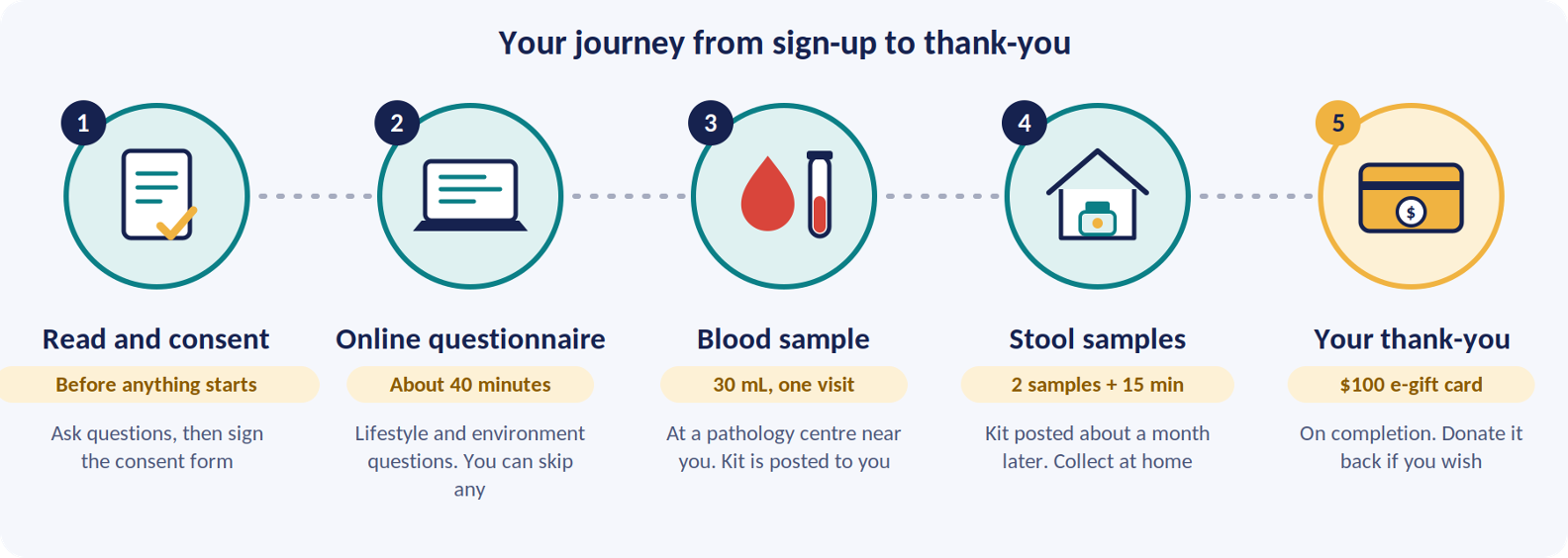
Why we need healthy volunteers
To spot what’s different in people who have had depression, researchers need to know what’s typical. Healthy volunteers, known as population controls, give us that baseline.
We compare their blood cells, genetics and gut bacteria against those of participants with depression. Without a control group, we can’t tell which biological differences relate to depression or antidepressant response and which are just normal variation between people.
You don’t need any experience of depression to make a difference. Your contribution makes the results from everyone else’s participation meaningful.
Who can take part
We are looking for adults who:
- Never been diagnosed at any time – You have never, at any point in your life, been diagnosed with depression, dysthymia, a mood disorder or an anxiety disorder. This includes past diagnoses, even if you have recovered.
- Never received treatment at any time – You have never, at any point in your life, been prescribed or taken antidepressants, mood stabilisers or anxiolytics (anti-anxiety medication).
- Australian resident, 18 or over – You live in Australia and you are at least 18 years old.
- No close family history – None of your first-degree biological relatives (parents, siblings, children) has ever had a mood disorder.
Project Update
Please find attached the latest newsletter, which includes updates and insights from the project to date. We hope you find it informative and engaging.
👥 Healthy Volunteers (Coming Soon)
We will be inviting individuals who have not been diagnosed with nor ever received treatment for depression or bipolar disorder to take part as control participants in the AGDS-CellO
Control participants play a vital role by providing comparison data that helps researchers identify meaningful patterns and differences between those who have experienced depression and those who haven’t. Your participation would involve completing questionnaires about your health and background, provide a blood and stool sample. If you’re interested, we’d be happy to share more details about what participation involves. If you are interested, email cello@uq.edu.au with:
- Your name
- Your contact number
- A short message saying you are interested
We would love to hear from you!

Contact Us
cello@uq.edu.au
07 3346 2089
Ms Deborah Gilroy
Institute for Molecular Bioscience, University of Queensland
Get In Touch
Please subscribe to our mailing list to stay informed.
About HSU
The Human Studies Unit at the University of Queensland is supporting the Cello study. At HSU, we combine laboratory and computing expertise to generate genomic data, and provide data management solutions, to advance understanding of common complex diseases and benefit those affected by them.